

The 100 Day Project #8
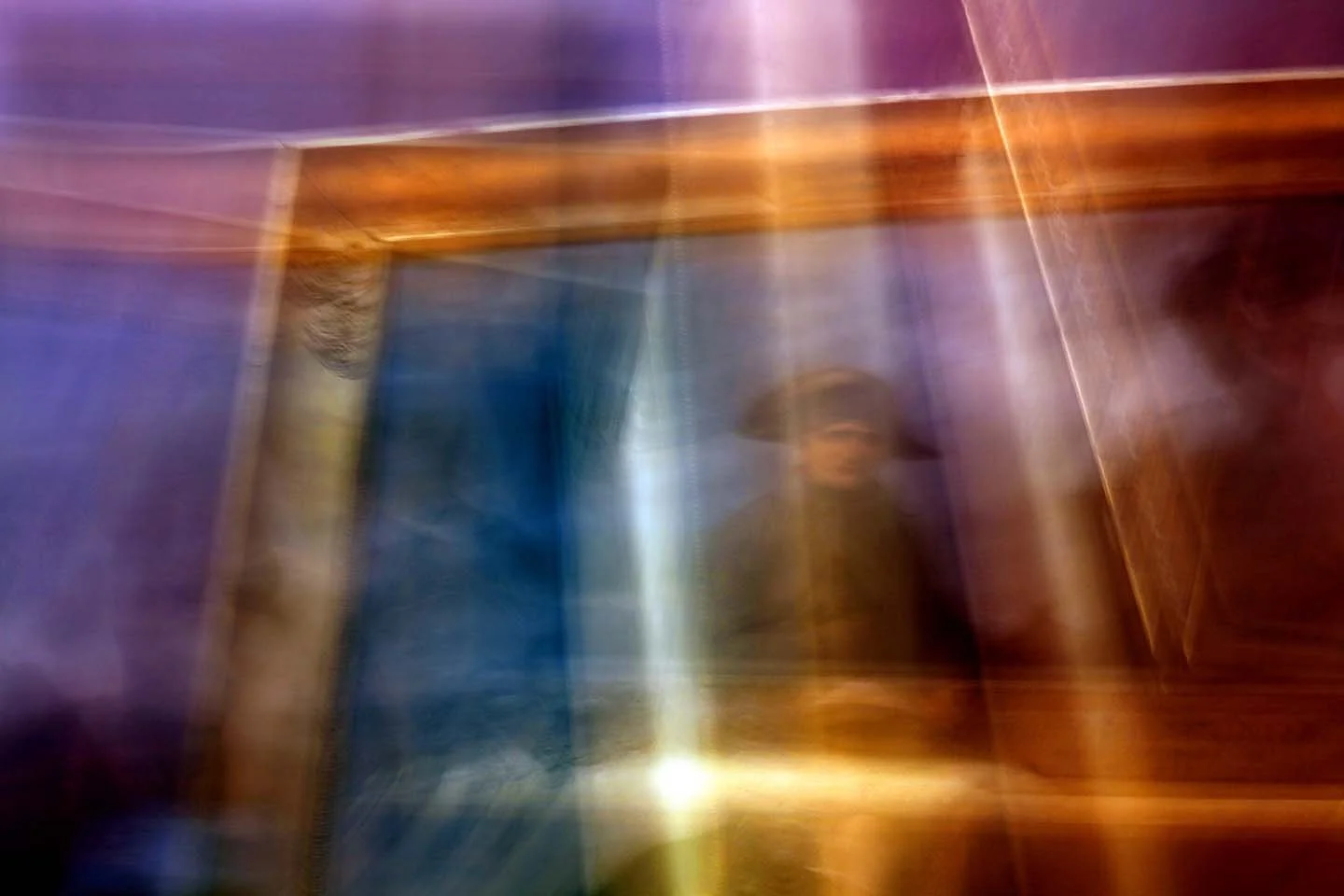
After Louise
The Louvre, Paris, France, 2014
The 100 Day Project, Day 8
About the photo:
Title: After Louise
Artist/Artwork: Paul Delaroche / Napolean Crossing the Alps
Location: The Louvre, Paris, France
Louise Vernet, wife of French painter Paul Delaroche, was also the daughter of French painter Horace Vernet. She died in 1845 at age 31 of a fever. It is said the Delaroche never recovered from the shock of her death.
As a lifelong student of art history and visual culture, I have long examined the complicated relationship between art and propaganda. Before the Industrial Revolution, monumental large-scale paintings were crafted to build narratives of power and wealth — of people, countries, and governments.
I made this photo in Paris while visiting The Louvre — a vast museum holding priceless objects that represent France's complex and conflicting history. Within its walls hang several paintings of Napoleon Bonaparte, many of them truly monumental, nearly covering entire walls. During Bonaparte's lifetime, a visual culture of heroism was constructed around him, much like today's leaders who plaster their names and faces on buildings and imagery to manufacture a cult of personality.
I've been thinking a lot in recent weeks about military invasions led by political plunderers in the name of empire. I was in London a couple of weeks ago, walking through the British Museum — another vast museum, a shrine to the spoils of empire and the timeless insatiability of men to conquer places and people. The chaos this causes. The destabilization that follows.
I have an immediate aversion to narcissists. I made the decision to estrange myself from my biological father, a man who in all my years of knowing him never put another person's needs above his own — and who used me as a pawn in his retribution campaign against my mother. It is not a far leap to say I am not a fan of Bonaparte, another narcissist. I spent a long while standing in front of Napolean Crossing the Alps, a massive painting made after Bonaparte's death b Paul Delaroche. For me, it was a relief to see a truer, corrective portrait — one that repositions him within the historical canon as just a man with a dark spirit.
In Delaroche's painting, Bonaparte is small, the Alps tower above him as he trudges through a cold and bland palette — a stark contrast to the golds and divine light of the propagandist paintings made during the height of his self-proclaimed reign as emperor of France.
The chaos in my photograph, After Louise, is intentional. The gilded frame commands the composition while the ghost of Bonaparte, easily recognizable in his famous hat, is trapped within it — a visual cage of my own making. The movement in my photograph mirrors the way the long arc of history shifts our collective understanding of a person's legacy — calamity, cruelty, or charity — dismantling over time whatever falsehood propaganda helped build.
This image is part of my project Co-Authored — a collection of abstract photographs born from my discomfort with artistic appropriation. I embarked on pilgrimages to photograph artworks in some of the most inspiring museums around the world, resulting in a collection that is playful and mysterious, yet sophisticated and elegant. Because museums are largely filled with art made by men, I titled each artwork after the partner or spouse of the artist whose work I photographed — my way of giving voice to the unrecognized support systems that have made so many male artists' careers possible.
About the 100 Day Project: A global creative challenge where thousands of artists share a piece of their practice every single day for 100 days. I'm joining creatives around the world, and I'm excited to bring you along. Each day I'll be sharing one of my photos — some recent, some old, and some from my current project — along with the story behind it: where I was, who I was with, and why I love it